
to track food bank stock accurately, record every movement at the moment it happens — food donated, food bought, parcels given out, and any corrections — in one place, against the same item list. The count is only as good as the least-recorded movement, and often that's the parcels going out. Link the parcel to the stock, and the count looks after itself.
Why is food bank stock so hard to keep track of?
A shop knows its stock because it orders it, prices it and scans it out at the till. A food bank has none of that discipline built in. Food arrives unpredictably from supermarket collections, churches, schools and individuals, often in mixed bags. Volunteers sort it in batches. Parcels go out several times a week, packed by whoever's on shift. And the person updating the stock sheet is often not the person who packed the parcels.
The scale is not small. UK redistribution organisations handled around 210,000 tonnes of surplus food in 2024, about three-quarters of it through charitable routes, according to WRAP's annual survey (Resource, reporting WRAP). That's before counting public donations to food banks directly. Every one of those tins, packets and bottles has to be counted in and counted out.
What does manual stock tracking look like?
This is a typical stock sheet at a small food bank on a Thursday morning. The figures are made up.
Item,In stock,Last updated,Updated by,Note
Baked beans (tin),64,Mon,JT,
Pasta 500g,38,Mon,JT,
Chopped tomatoes (tin),41,Fri,AK,
UHT milk 1L,22,Fri,AK,"church drop, not counted yet"
Tea bags 80,9,Tue,?,
Cereal,30,Mon,JT,
It looks tidy, but read the Last updated column. Tuesday's session gave out 25 parcels, and only one line was updated afterwards. Friday's figures predate a church donation that's still in crates. Nobody knows who updated the tea bags.
The usual manual routine is:
1. Donations are sorted onto shelves, and someone adds them to the sheet later — sometimes by weight, sometimes by item, sometimes not at all.
2. Purchases are recorded in the finance spreadsheet, not the stock sheet.
3. Parcels are packed from a printed list. Nobody subtracts the items, because it would mean editing 20 rows after every session.
4. Once a month or so, volunteers do a full stock take and overwrite the sheet with the real numbers.
Between stock takes, the sheet is a guess.
What happens when food bank stock isn't tracked properly?
You run out mid-session. The sheet says 22 cartons of milk; the shelf has six. The coordinator finds out when a packer comes back empty-handed, and someone either runs to the shop or households go without.
You buy what you already have. Without an accurate count, it's easy to spend scarce cash on pasta while a donated pallet of it sits unsorted in the back room.
Food goes to waste. Stock that isn't counted isn't rotated. Items sit at the back of a shelf until they're past their date — the opposite of what donors gave them for. (Our guide to preventing food expiry covers dates in detail.)
You can't tell donors or funders what happened to their food. "How many kilos did we give out this year?" and "Where did the supermarket's donation go?" are fair questions. A sheet that's overwritten once a month can't answer them.
Stock takes eat volunteer time. A full count every few weeks is the only way to reset an unreliable sheet, and it's work that adds nothing for the people you support.
How should a food bank track its stock?
Think of your stock count as a balance. It only changes in six ways, and if you record all six as they happen, you never need to guess.
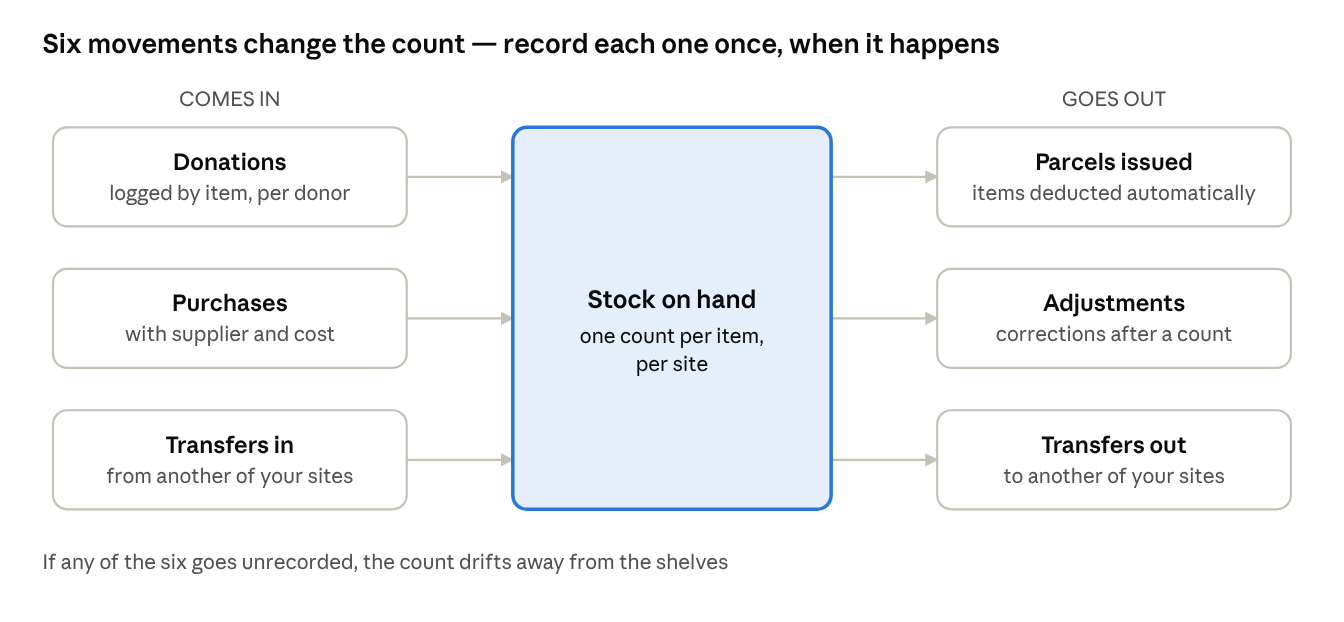
every way stock moves · 3 in, 3 out
A reliable routine, with or without software:
1. Agree one item list. "Beans", "baked beans" and "Heinz beans 415g" should be one item. Decide whether you count by unit or by weight, and stick to it for each item.
2. Log donations on arrival, not after sorting. Note who gave it and what it was, so you can thank them and report on it.
3. Log purchases in the same place as donations, with the supplier and cost, so stock and spending agree.
4. Take parcels out of stock as they're issued. This is the movement most often skipped. If you use standard parcels, one parcel should equal a fixed set of items.
5. Record corrections, don't overwrite. When a count finds a difference, record it as an adjustment, so you can see how big the gaps are and where they come from.
6. Move stock between sites on the record. If you run more than one site, a van of tins from one hall to another is a transfer, not a mystery.
7. Count a few lines every week instead of everything once a month. Small, regular checks catch drift early.
What should you look for in food bank inventory software?
Generic stock software is built for shops and warehouses. Food bank stock has its own quirks, so ask:
|
Question to ask |
Why it matters |
|
Does issuing a parcel take its items out of stock automatically? |
This is the movement most often missed by hand |
|
Are donations and purchases recorded separately? |
You need to know what was given and what you paid for |
|
Is each donation linked to its donor? |
So you can thank donors and report on their giving |
|
Can it tell you how many parcels current stock can make? |
That's the question a coordinator actually needs answered |
|
Are there low-stock and expiry alerts, and can you set the thresholds? |
A fast-moving item needs an earlier warning than a slow one |
|
Can you record adjustments after a count? |
Corrections should be visible, not silent overwrites |
|
Does it support barcodes? |
Faster, more consistent item entry on busy days |
|
If you have several sites, does each have its own stock, with transfers between them? |
A single network-wide total hides local shortages |
|
Does it record weight as well as item counts? |
Many funders and networks report in kilograms |
How does FoodBank360 track food bank stock?
FoodBank360 records all six movements in one place, so the count on screen is the count on the shelf:
• Donations in: each donation is logged item by item against its donor, with a receipt number, and the items go straight into stock.
• Purchases in: food you buy is logged separately, with the supplier and the cost.
• Parcels out: you build parcels from templates (adult, child, vegetarian, kettle, plus additional adult and child parcels for bigger households). Issuing a parcel deducts its items automatically.
• How many can we make? The Calculate Stock button on each parcel template shows how many of that parcel your current stock can build.
• Alerts: low-stock and expiry-date alerts flag what to reorder and what to use first. You set when each alert fires, depending on how fast an item moves and how easy it is to replace.
• Barcodes: items can be entered by barcode.
• Adjustments: after a count, you can record a stock adjustment rather than overwriting the figure.
• Multiple sites: each site has its own stock, stock can be transferred between sites, and reports can be run per site.
• Reporting: the dashboard shows current stock and total food weight, and the Items report gives the detail.
One honest limit: adjustments don't yet have a separate reason for damaged or spoiled stock. If you need that, tell us — it can be added on request.
Stock tracking is part of the Full plan, at £114.99 a month plus VAT (20% less if paid yearly), with unlimited users. See pricing →
Food bank stock FAQs
Should a food bank count stock by item or by weight? By item for anything that goes into a parcel, because parcels are packed by item. Record weight as well if your funders or network report in kilograms. Whichever you choose, be consistent for each item.
How often should a food bank do a stock take? If parcels are taken out of stock as they're issued, a full stock take becomes a check rather than a reset. Counting a handful of lines each week — rotating through the list — catches problems earlier than one big monthly count.
Is there a free food bank inventory spreadsheet? Generic inventory templates are easy to find, and they work for a very small operation. Their weakness is that parcels going out aren't linked to the stock list, so the count drifts between sessions. See FoodBank360 vs spreadsheets for a side-by-side comparison.
How do you track donated food separately from bought food? Record them as two kinds of movement into the same stock list: donations against the donor, purchases against the supplier with the cost. You get one count, plus a clear split for reporting.
We have two sites. Should they share one stock list? No — give each site its own count and record transfers between them, otherwise a shortage at one site is hidden by a surplus at the other. In FoodBank360, each extra location is £25 a month on top of your plan.
Know what's on your shelves before the session starts
Book a free demo and bring your current stock sheet. We'll show you how your items, parcel templates and donations would look in FoodBank360.
Book a free demo · Foodbank management system · How to prevent food expiry