
Book each delivery to a specific date when the referral is approved, give each driver a single list for their run, and record the outcome of every drop — delivered or not home. Any drop that fails is rebooked straight away, not left for someone to remember. The route itself can be planned by the driver; what matters most is that every parcel has a date, a driver and a status.
Why are food bank deliveries hard to manage?
Delivery is how food banks reach people who can't get to a distribution centre — older people, disabled people, people without transport, parents who can't bring small children across town. It's also the hardest part of the operation to keep track of, because it happens away from the building.
Once a parcel leaves the hall with a volunteer driver, the coordinator usually loses sight of it. Did it arrive? Was anyone in? Was the address right? The answers come back by text, phone call or not at all.
How are food bank deliveries usually organised?
A common manual routine:
1. The coordinator looks through the week's approved referrals and picks out the households that need delivery.
2. She works out who's driving from the volunteer rota spreadsheet, or a group chat.
3. On the day, she sends each driver a message with names, addresses and phone numbers, sometimes as a photo of a printed list.
4. Drivers plan their own route and set off.
5. Drivers text back if someone wasn't in. The coordinator makes a note to rebook them — on paper, in the spreadsheet, or in her head.
What goes wrong?
• Missed drops fall through the gap. A "not in" text at 3pm on a busy Thursday is easy to lose. The household waits for a delivery that was never rebooked.
• Personal data ends up on personal phones. Names, addresses and phone numbers sent by message stay on volunteers' devices long after the run. UK GDPR expects you to keep personal data secure and only for as long as you need it (ICO: data protection principles).
• Drivers are double-booked or missing. When the rota and the delivery list live in different places, a run can have no driver, or two.
• Nobody knows what's outstanding. Without a status for each drop, "how many deliveries are still to go out this week?" means ringing round.
• Reports undercount delivery work. Deliveries take a lot of volunteer time, but if they're not recorded properly they barely show up in reports.
How should a food bank schedule deliveries?
Good delivery scheduling is less about the perfect route and more about making sure no drop is forgotten.
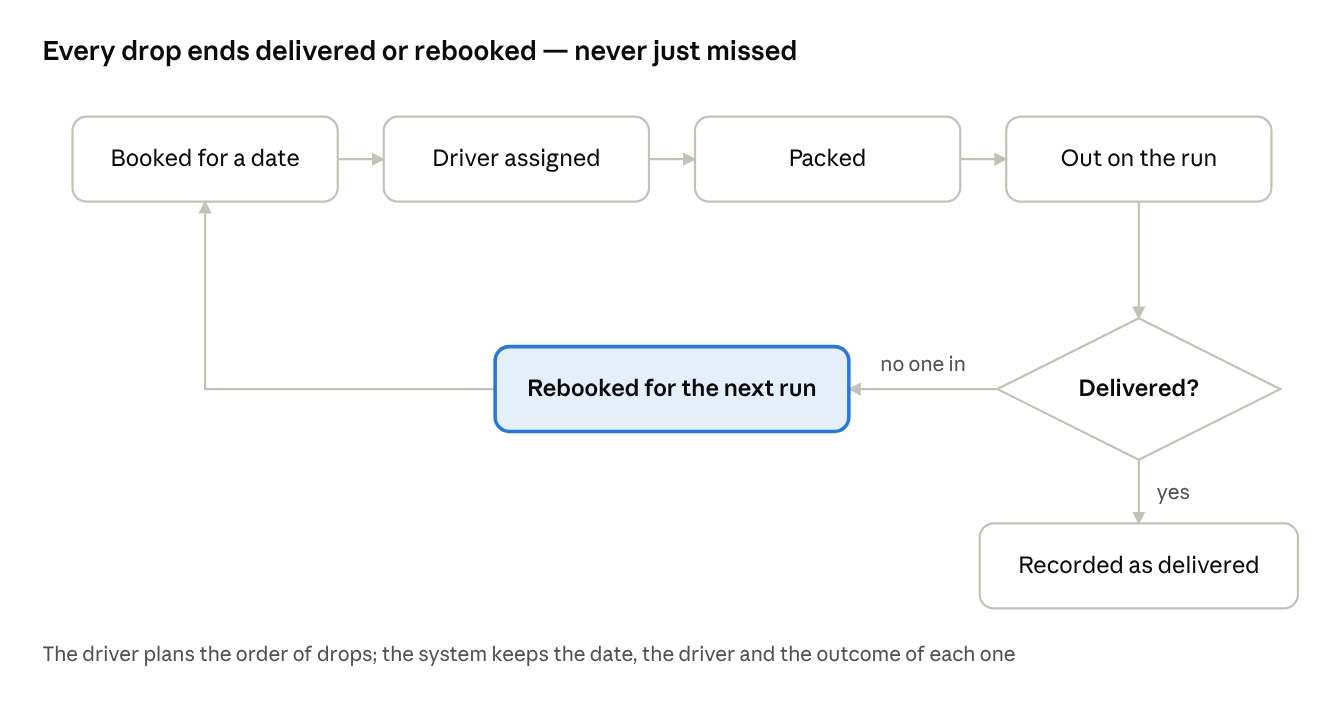
one delivery's journey · 1 decision, 1 loop back
A routine that works with or without software:
1. Decide delivery at approval. When you approve a referral, record whether it's collection or delivery, and why delivery is needed.
2. Book a date, not just "this week". Each delivery gets a specific run.
3. Assign drivers from the rota. Plan delivery runs and the driver rota together, so every run has exactly one driver.
4. Give each driver one list. Names, addresses, a contact number, any access notes, and only for their run. A printed list collected back at the end, or a list on a secure system, beats a forwarded message.
5. Let drivers choose the order. A local volunteer usually knows the best way round; you don't need routing software to get the parcels out.
6. Record every outcome. Delivered or not home, for each drop, on the day.
7. Rebook failures immediately. A failed drop goes onto the next run before the coordinator goes home, and the household is contacted.
What should you look for in food bank delivery software?
|
Question to ask |
Why it matters |
|
Is collection or delivery recorded on each parcel? |
So delivery work is planned and reported, not improvised |
|
Can drivers see their list on a phone, and can it be printed? |
Drivers vary: some want a phone, some want paper |
|
Does each drop have a status the driver can update? |
So the coordinator knows what's outstanding |
|
Are missed deliveries tracked and easy to rebook? |
Stops households falling through the gap |
|
Is the driver rota in the same system as the deliveries? |
Avoids runs with no driver, or two |
|
Can driver access be limited to their own run? |
Drivers shouldn't see every household's details |
|
Does it plan routes? |
Useful for very large delivery operations; many food banks manage without it |
How does FoodBank360 schedule food bank deliveries?
• Collection or delivery on every parcel. Each outgoing parcel is marked for collection or delivery and has its own status.
• A scheduling pipeline on the dashboard. The dashboard groups work into needs scheduling, needs packing, needs delivery, upcoming in the next 7 days, and the check-in queue.
• A delivery list drivers can use. Drivers are set up as their own staff type. Their scheduled delivery list can be viewed on a phone or printed.
• Missed delivery and redelivery tracking. A failed drop is recorded and can be rebooked for a later run.
• One rota for packing and delivery. Volunteer shifts — including delivery runs — are planned in the same system, with sign-up and staff assignment.
• Role-based access. Drivers see only their own run — the deliveries assigned to them, not every household on your books.
What it doesn't do: FoodBank360 doesn't plan or optimise driving routes. Drivers or your team decide the order of drops.
Delivery scheduling starts on the Scheduler plan, at £74.99 a month plus VAT (20% less if paid yearly), with unlimited users. See pricing →
Food bank delivery FAQs
Do food banks deliver food parcels? Many do, usually for people who can't travel to a distribution point. It's normally arranged through the referral, so check with your local food bank how it works there.
What should a delivery driver's list include? Only what the driver needs for their run: name, address, a contact number, access notes and the parcel to deliver. Avoid sharing reasons for referral or other household details.
What should happen if nobody's in? The driver records it, the parcel comes back (or is stored safely if it contains chilled food), and the household is rebooked for the next run and contacted.
Do we need route-planning software? Not usually. For a handful of runs a week, a local driver choosing the order works fine. What matters more is that every drop is booked, assigned and recorded.
Should delivery drivers have a DBS check? It depends on the role and what the driver does. See our guide to managing food bank volunteers for how to decide.
Know where every delivery is
Book a free demo and we'll show you the delivery list, statuses and rebooking in FoodBank360, alongside your volunteer rota.
Book a free demo · How to manage food bank referrals · Foodbank management system