
to manage food bank referrals well, every referral should arrive in one place, be checked against the people you already support, get a clear yes or no from a named person, and be booked into a specific collection or delivery. If a household misses its slot, it should be rebooked rather than lost. That works on paper for a handful of referrals a week; beyond that, it needs a system that keeps the whole journey in one record.
Why are food bank referrals hard to manage?
Many UK food banks work on referral. As Citizens Advice puts it, "you'll usually need to get a referral to a food bank before you can use it", and that referral can come from a GP, a housing association, a social worker or Citizens Advice itself. Each new visit usually needs a new referral.
That model is sensible — the referrer knows the household's situation, and the food bank can focus on food. But it means a single food bank can receive referrals from dozens of organisations, each with its own habits. One emails a PDF, another phones, a third hands the family a paper voucher to bring in. The food bank's job is to turn all of that into one reliable list of who is coming, when, and for what.
What does the manual referral process look like?
Here's a typical Monday morning inbox at a small food bank still managing referrals by email and phone. The names and details are made up.
|
Arrived |
From |
Format |
Household |
What's missing |
|
Fri 16:52 |
Housing officer |
Email with attached Word form |
2 adults, 3 children |
Dietary needs left blank |
|
Sat 10:15 |
GP surgery |
Voicemail |
"A mum and two kids" |
Address; surname spelled out unclearly |
|
Sun 21:03 |
School family worker |
Email, details in the body |
1 adult, 2 children |
Nothing — but it's the same family as Friday's referral |
|
Mon 08:40 |
Walk-in |
Paper voucher from Citizens Advice |
1 adult |
Voucher date is three weeks old |
The coordinator's process from here is usually:
1. Read each email and listen to each voicemail.
2. Type the details into a referrals spreadsheet, chasing anything missing by phone.
3. Scroll or search the spreadsheet to see if the household has been before.
4. Decide whether to accept the referral, often based on memory of how often the family has visited.
5. Text or ring the household with a collection day.
6. Write the name on the session list for that day.
7. Afterwards, mark who came — if anyone remembers to.
None of these steps is difficult. The problem is that the referral exists in four or five places (the inbox, the spreadsheet, the coordinator's phone, the session list, a paper voucher), and they drift apart.
What goes wrong when referrals are managed by hand?
Referrals get missed. A voicemail left on Saturday or an email that lands in a shared inbox's spam folder can sit unread while a family waits. Nobody sees a backlog, because there's no single list to see.
The same household appears twice. In our example, Friday's housing referral and Sunday's school referral are the same family, sent by two agencies who don't know about each other. Typed in as two rows, they look like two households. That splits the family's history and can make your numbers look bigger than they are.
Visit limits are applied from memory. Many food banks set a guideline on how often a household can be referred before a conversation about longer-term support. Cardiff Foodbank's agency handbook, for example, describes a "three-voucher guideline, not a rule or restriction", with referrals beyond three in six months flagged for review (Cardiff Foodbank e-referral handbook). A guideline like that only works if someone can see how many times a household has been referred — hard to do if the household is in the spreadsheet under two spellings.
Missed collections disappear. If a family doesn't turn up, the referral often just stops. Nobody rebooks it, and the agency that referred them never finds out.
Referrers are left guessing. Agencies have no way to check whether their referral arrived or was fulfilled without phoning you, which costs both sides time.
Personal data spreads. Names, addresses and household details end up in inboxes, voicemails, phones and printed lists. Under UK GDPR, you're responsible for keeping that data secure and only as long as you need it (ICO: data protection principles). Every extra copy makes that harder.
What does a good food bank referral process look like?
Whatever tools you use, a reliable referral process has the same shape: one way in, two decisions, and no dead ends.
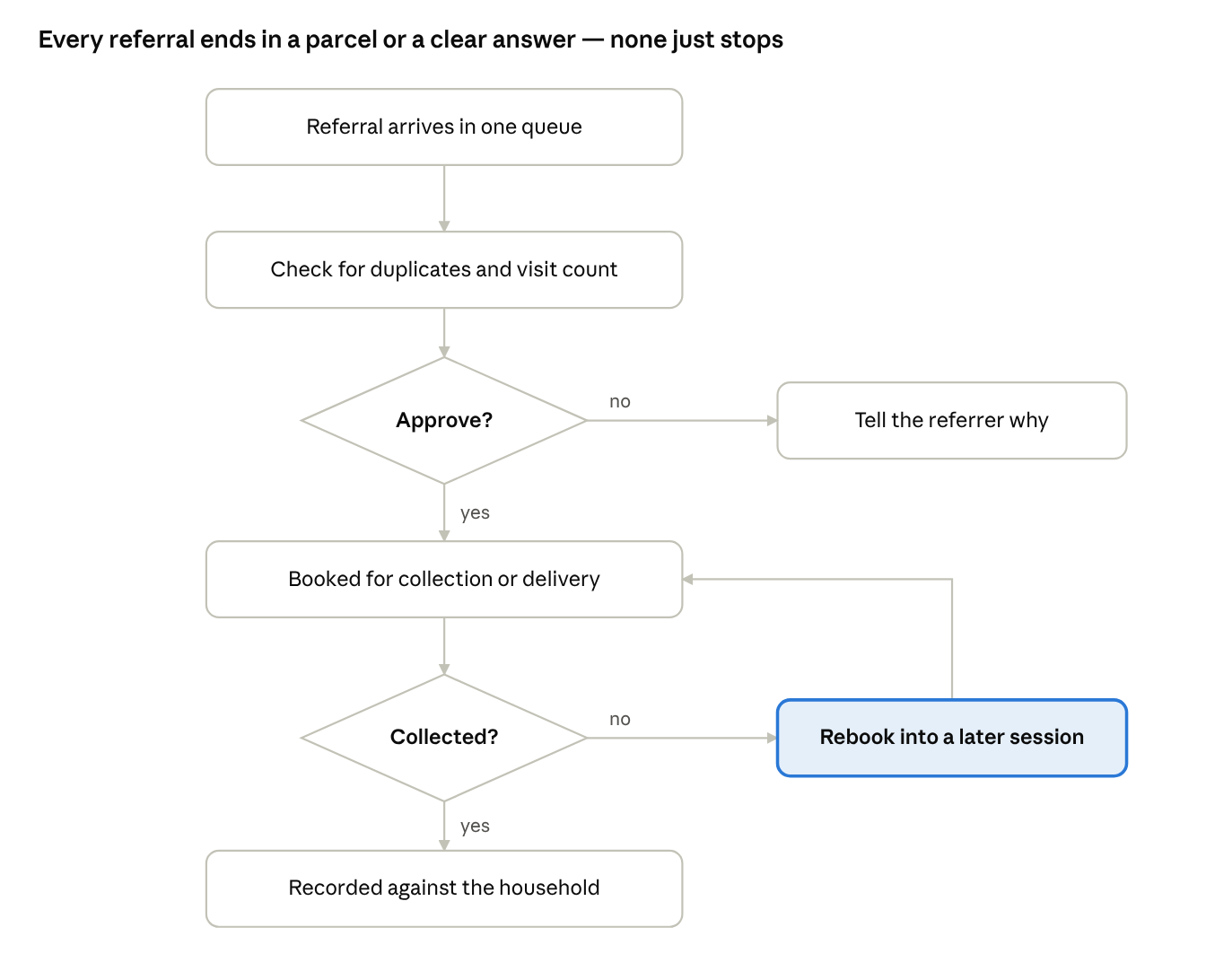
one referral's journey · 2 decisions, 1 loop back
In practice, that means six habits you can adopt today, even on paper:
1. Give referrers one way to reach you. One form, one email address or one online system — not "whatever's easiest for you". Tell agencies exactly what information you need: household size, ages, dietary needs, contact details and consent.
2. Log every referral the day it arrives, in one list that shows its status: received, approved, booked, collected, declined.
3. Check before you approve. Search for the household by surname and postcode, not just name, and look at how many times it's been referred recently against your visit guideline.
4. Make a named decision. Someone approves or declines each referral. If you decline, tell the referrer why, so they can find another route.
5. Book a specific slot. A day and time for collection, or a delivery date, recorded against the referral.
6. Close the loop. Mark each referral collected or not. If not, rebook it into a later session and let the referrer know, rather than letting it quietly expire.
What should you look for in food bank referral software?
If you're comparing systems — ours or anyone else's — these are the questions that matter for referrals:
|
Question to ask |
Why it matters |
|
Can referral agencies submit referrals online themselves? |
Removes retyping, and every referral arrives in the same format |
|
Do you control which agencies can refer, and can you suspend one? |
Keeps referrals coming only from organisations you trust |
|
Can referrers see the status of their own referrals — and only their own? |
Saves phone calls without exposing other households' data |
|
Does it flag likely duplicates before you approve? |
Catches the same family referred by two agencies |
|
Can you set a visit limit and see how close a household is to it? |
Lets you apply your guideline consistently, not from memory |
|
Does every referral need a staff decision? |
Keeps a person responsible for each approval |
|
Can a missed collection be rebooked without a new referral? |
Stops households falling out of the system |
|
Does the referral link to the parcel and to reports? |
Avoids keeping referral and parcel records in separate places |
|
How much does each referral partner login cost? |
Per-user pricing can make adding agencies expensive |
How does FoodBank360 manage food bank referrals?
FoodBank360 follows the same journey shown above, with each step recorded against one household:
• Referral partners register and you accept them. An agency can't refer until your team has accepted it, and you can suspend a partner at any time.
• Partners refer online. Accepted partners log in, submit referrals with household size and dietary needs, and can see the status of their own referrals — not anyone else's.
• Every referral waits for approval. New referrals land in a pending approval queue on the dashboard. Nothing is approved automatically.
• Likely duplicates are flagged. FoodBank360 checks new referrals against existing households and flags possible duplicates for a person to review.
• Visit limits are yours to set. You can set a limit on how many times a household can be referred, and see each household's history before deciding.
• Missed slots are rebooked. A household that misses its collection can be moved to a later session, so the referral isn't lost.
• It all feeds the parcel and the report. An approved referral becomes a parcel built from your stock, and the Referrer Organisations report shows referral numbers by agency.
What it doesn't do: referral partners can't see your stock or session availability before they refer, and FoodBank360 doesn't connect to external case-management or council systems. Referrals come in through FoodBank360 itself.
Referral management is included in every plan, starting with Referrer at £34.99 a month plus VAT, with unlimited staff and referral partner logins. See pricing →
Food bank referral FAQs
How many times can someone be referred to a food bank? It depends on the food bank. Many set a guideline rather than a hard rule — Cardiff Foodbank, for instance, flags referrals beyond three in six months so that someone can talk to the household about longer-term support. Decide your own guideline, write it down, and apply it consistently.
What happens if a household misses its collection? Ideally, the referral is rebooked into a later session and the referrer is told, rather than the family needing a brand-new referral. Make this a written step in your process so it doesn't depend on who's on shift.
Can people refer themselves to a food bank? Some food banks accept self-referrals and some, often church-run projects, need no referral at all (Citizens Advice). If you accept self-referrals, give them the same checks as agency referrals.
What information should a food bank referral include? At minimum: name, address or "no fixed address", the number of adults and children, dietary needs, a contact method, who referred them, and the household's consent to share the information. Only collect what you'll use.
Should referrals be declined? Sometimes — for example, if a household is already booked this week. When you decline, tell the referrer why, so the household isn't left without help.
Bring your referral process into one place
Book a free demo and walk us through how referrals reach you today. We'll show you the same process in FoodBank360, from partner sign-up to collected parcel.
Book a free demo · Foodbank management system · Software for referral teams