
Treat referral agencies as partners with a clear start: an approval step, a short agreement about data protection and what a good referral includes, and their own login to refer and follow their referrals. Keep a list of active partners, review it once a year, and suspend access when an agency stops using it or a contact leaves. Then report back to each partner on what their referrals led to.
Why do referral partners need managing at all?
A referral-based food bank depends on other organisations to identify who needs help. Citizens Advice lists GPs, housing associations, social workers and Citizens Advice itself among the organisations that can refer people. A busy food bank can work with dozens of them.
Each partner has its own staff, habits and turnover. Without some structure, you end up with referrals of very different quality, no clear idea of who's allowed to refer, and former staff at partner agencies who still have the referral form bookmarked. The established e-referral systems in the UK handle this with an approval step: Cardiff Foodbank, for instance, invites agencies to use e-referral, asks them to agree to a data protection statement, and can turn off an agency's access if needed (Cardiff Foodbank e-referral handbook).
How do food banks usually manage referral agencies?
Without a system, "managing partners" usually means:
• A list of agency contacts in a spreadsheet or the coordinator's email contacts, rarely updated.
• A referral form (Word document or paper voucher) that anyone with a copy can use.
• Phone calls from agency staff asking "did our referral come through?"
• No record of which agency referred whom, beyond a note in the referrals sheet.
What goes wrong?
• You don't really know who's referring. A form that's been forwarded around can be used by anyone, including people at organisations you've never agreed to work with.
• Referral quality varies. Without agreed standards, some agencies send everything you need and others send a name and a phone number.
• Agencies chase you for updates. Every "did it arrive?" call takes time on both sides.
• Former staff keep access. When an agency worker moves on, nobody tells the food bank, and the old email address still sends referrals.
• You can't tell partners what they achieved. Agencies value hearing how many of their referrals were fulfilled; without records by agency, you can't say.
• You can't see where need is coming from. Knowing which agencies refer most — and which have gone quiet — helps you plan outreach and spot gaps.
How should a food bank manage its referral partners?
Think of each partner as having a lifecycle: a clear way in, an active period, a regular check, and a way out.
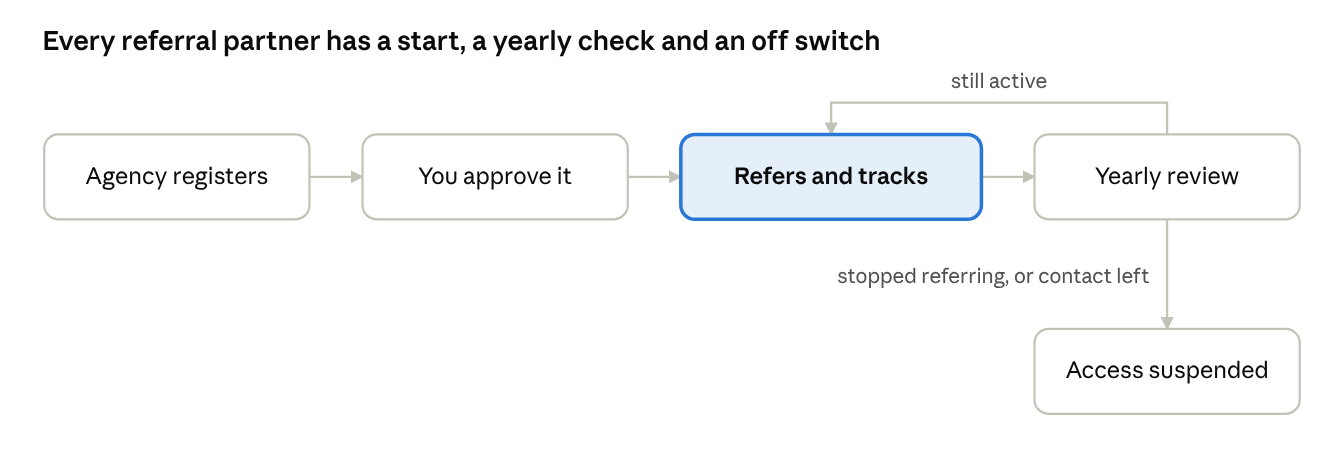
a referral partner's lifecycle · 1 loop, 1 exit
Onboarding checklist for a new referral partner:
• ☐ The organisation has registered or been invited, with a named lead contact.
• ☐ You've confirmed it's an organisation you want to accept referrals from.
• ☐ It has agreed to your data protection terms, including getting the household's consent before referring.
• ☐ It knows what a complete referral includes: household size, ages, dietary needs, contact details and consent.
• ☐ It knows your visit guideline and what happens when a household reaches it.
• ☐ It knows how to check the status of its referrals.
• ☐ It has a contact at your food bank for questions.
Running the partnership:
1. Give each partner its own access. Logins tied to the organisation, so you always know who referred whom.
2. Let partners see their own referrals — and only their own. It saves phone calls and protects other households' data.
3. Report back. Share each partner's numbers once or twice a year: referrals sent, fulfilled and not collected.
4. Review every partner annually. Is it still referring? Is the lead contact still there? Are referrals complete?
5. Suspend promptly. If an agency stops referring, or its contact leaves without a replacement, switch off its access until it's sorted.
What should you look for in referral partner software?
|
Question to ask |
Why it matters |
|
Can agencies register, with your approval before they can refer? |
You decide who refers to you |
|
Can you suspend a partner's access? |
Closes the door when an agency goes quiet or staff leave |
|
Do partners see the status of their own referrals, and only theirs? |
Fewer chasing calls, and other households' data stays private |
|
Does the system count referrals per partner? |
Lets you report back and spot agencies that have gone quiet |
|
Is there a report by referring organisation? |
Useful for funders, planning and partner reviews |
|
Is there a cost per partner login? |
Per-user pricing makes adding agencies expensive |
How does FoodBank360 manage referral partners?
• Registration and approval. Agencies can register themselves, and you accept them before they can refer. You can also add a partner yourself.
• Suspend at any time. Each partner's status can be changed, so you can suspend access when it's no longer needed.
• Partners see their own referrals. Once accepted, a partner logs in, refers online, and sees the status of the referrals it has sent — not anyone else's. Each partner's account is managed by a lead contact; if an agency needs logins for more staff, your team can add them.
• Referral counts per partner. The partner list shows how many people each organisation has referred.
• Referrer Organisations report. A built-in report breaks referrals down by referring organisation, for partner reviews and funders.
• Unlimited partner logins. Every plan includes unlimited referral partners, so adding an agency costs nothing.
What it doesn't do: partners can't see your stock or session availability before referring, and FoodBank360 doesn't connect to agencies' own case-management systems. Partners refer through FoodBank360 itself.
Referral partner management is included from the Referrer plan, at £34.99 a month plus VAT (20% less if paid yearly). See pricing →
Referral partner FAQs
How does an organisation become a food bank referral agency? Usually by contacting the food bank, agreeing to its terms (including data protection), and being given access to its referral system or vouchers. Each food bank sets its own process.
Which organisations make good referral partners? Organisations that already know the household's circumstances: GPs, housing associations and housing teams, social workers, schools, advice services such as Citizens Advice, and other charities.
Should referral partners be able to see the status of their referrals? Yes — their own referrals only. It saves phone calls and helps them support the household, without exposing anyone else's details.
How often should we review our referral partners? Once a year is a good rhythm: check each partner is still active, the contact is still in post, and referrals are arriving complete.
What should we do when an agency stops referring? Get in touch first — it may be a staffing change. If it's no longer active, suspend its access until it's ready to start again.
Know exactly who refers to you
Book a free demo and we'll show you partner registration, approval, status tracking and the Referrer Organisations report in FoodBank360.
Book a free demo · How to manage food bank referrals · Software for referral teams